 |
|||||||||
|---|---|---|---|---|---|---|---|---|---|
 |
Oxyrhynchus
Are the "Early Dated" Christian | Web Publication by Mountain Man Graphics, Australia
 | |||||||
|
|
|||||||||
|---|---|---|---|---|---|---|---|---|---|
|
Oxyrhynchus
Are the "Early Dated" Christian | Web Publication by Mountain Man Graphics, Australia
| |||||||
INTRODUCTION: The hypothesis that "the codex was a deliberate innovation of Christian evangelists"".
1. PreConstantinian papyrii fragments and manuscripts
1. Early Fragments from the New Testament Canonical "Books"
2. Early Fragments from the New Testament Non Canonical "Books"
2. Dating process: paleography
3. Oxyrhynchus Population Demographics
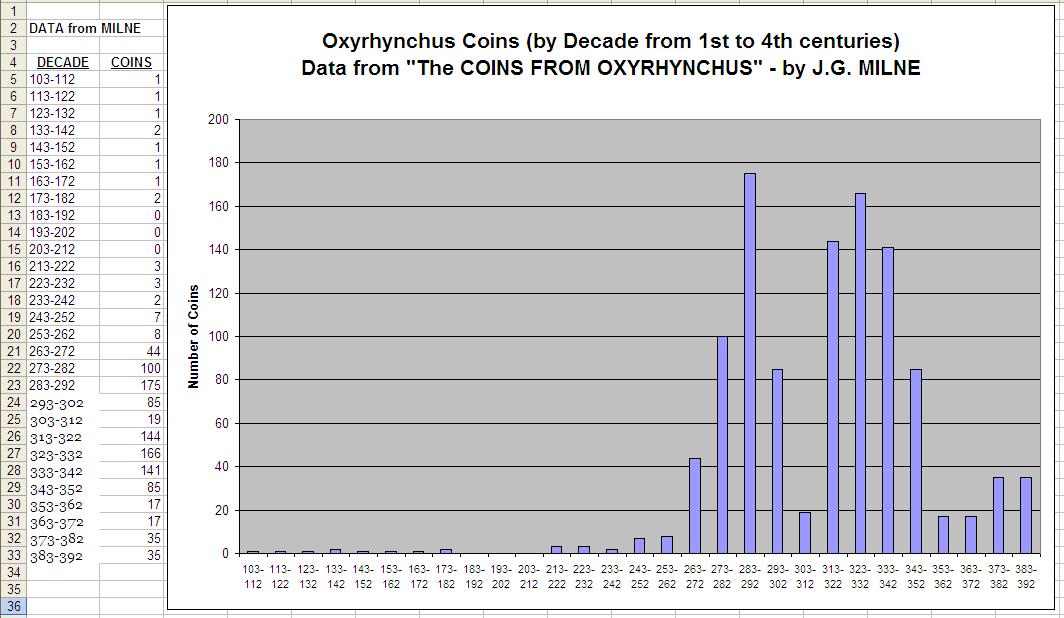
4. Oxyrhynchus Coins - An Analysis following Milne
5. Dating process: C14 Radio-Carbon Dating Analysis
6. The Fragments are from Codices - not Scrolls
7. The Comparanda are all taken from "Common Empire Scribes"
8. The Appearance of Crosses + on Oxyrhynchus Papyri
9. Sacred Scriptures as Trash: Biblical Papyri from Oxyrhynchus: by AnneMarie Luijendijk [2010]
10. The Typology of the Early Codex: Eric G. Turner [1970]
11. Grenfell and Hunt on the Dates on Early Christian Codices:Setting the Record Straight: by Brent Nongbri [2011]
12. Early New Testament Manuscripts and Their Dates: A Critique of Theological Palaeography: Pasquale Orsini & Willy Clarysse [2012]
13. The Limits of Palaeographic Dating of Literary Papyri: Date/Provenance P.Bodmer II (P66): Brent Nongbri [2014]
14. Extract from Milne's 'A History of Roman Egypt'
However, in the second paragraph, the author states ...

PreConstantinian papyrii fragments and manuscripts |
|---|
The Bodmer papyri: The major papyri in this collection are p66, p72, p75.
p66: 150-200 CE, contains almost all of the Gospel of John
p72: 200's, containing all of I & II Peter, Jude
p75: 175-200 CE, contains most of Luke 3-18, 22-24; John 1-15.
The Rylands papyrus: Asserted to be the earliest surviving new testament fragment of a papyrus codex containing John 18:31-33, and 37. It has been dated from 130 CE.
Other papyrii: Papyrus Oxyrhynchus 658 dated to 250 CE, P. Oxy. 1464 dated to 250 CE, P. Oxy. 2990 dated to the third century, and a whole swag of others.
Dating process: paleography |
|---|
 The dating process used to assess the estimated date of all the above
manuscripts and fragments is called paleography, and resembles handwriting
analysis. The example provided to the left is called P.Oxy.104
The dating process used to assess the estimated date of all the above
manuscripts and fragments is called paleography, and resembles handwriting
analysis. The example provided to the left is called P.Oxy.104While it may be reliable, paleographic assessment is only an estimate. It is usually considered along with a host of other dating techniques, and is rarely used without any other corroboration, as it is with the pre-4th century "Early Christian Papyri" fragmnents, in isolation and an authority. For example, if a manuscript were to be written in 325 CE, but in the more ancient Hadrian script, the paleographic assessment would tend to place the MS in the time of Hadrian. Paleographic assessment cannot be relied upon as a primary method of dating, unlike C14 analysis, or a dated fragment, for example.
We need an outline of the reasons by which the handwriting
script out of which these 110 greek letters is fashioned
could not have been used in the fourth century.
Additionally, looking at the image you will see a number
of the papyri edges that are "floating free" and which
contain no writing at all. What's the problem with
sending these to the C14 lab?
Oxyrhynchus Population Demographics |
|---|
The city is described then as dual -- one city inside the walls became so overcrowed that another then formed outside the walls. The claim that anyone has walked into Oxyrhynchus and managed to find 2nd and/or 3rd century "christian papyri fragments" is not supported by the demographic evidence. Grenfell and Hunt employ local Egyptians at a few pence per day to gather up the fragments from over seventeen ancient rubbish dumps around Oxyrhynchus.

The fragments are then securely packed in biscuit tins and placed into a series of over 900 brief cases sized boxes and sent back to Oxford in the early twentieth century. Perhaps detailed academic analysis has made its way through at least 128 boxes to date.
The conjecture that the papyri fragments from the Oxy tips predate the extreme explosion of its population demographics is not logical. Neither does it seem to be supported by the carbon dating process. .
Oxyrhynchus Coins - An Analysis following Milne |
|---|
Dating process: C14 Radio-Carbon Dating Analysis |
|---|
Our response to this mass of paleographic dating before the time of Constantine is to urge a carbon dating process to be undertaken on any of these purported NT fragments or manuscripts. This will either lend support to the existing paleopgraphic dating, or it will not. Unfortunately these fragments are not amenable to C14 analysis due to their contamination with the environment, and manual handling in the modern epoch by the archaeological teams.
To my knowledge (2013) there has been no results published in respect of any carbon dating test of a manuscript or fragment of the new testament canon.
The one extant C14 citation in the field is in respect of Codex Tchacos containing non canonical texts:
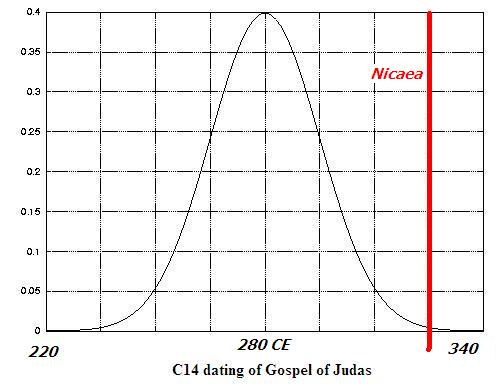
(1) 280 CE (+/- 60 years) for the Tchacos Codex containing the Gospel of Judas.
This result may be depicted diagramatically as follows. However in this instance it should be noted that in this case, most of the members of the investigative teams prefer a date in the fourth century.
(2) the Nag Hammadi Codices containing Gospel of Thomas are dated via cartonage (and other means) to the mid 4th century.
PREDICTION
This provides an opportunity of making a prediction, namely that the carbon dating (or dating via any new technology) of any NT manuscript or fragment will yield a date no earlier than Constantine (c.325 CE). Further, it is envisaged that technological advances may yield a new method of dating such archaeological fragments, perhaps for example, a method to detect the age of the oldest water molecules in the specimen, without having to destroy the specimen. Such technology may arise from multi-spectral imaging.
The Fragments are from Codices - not Scrolls |
|---|
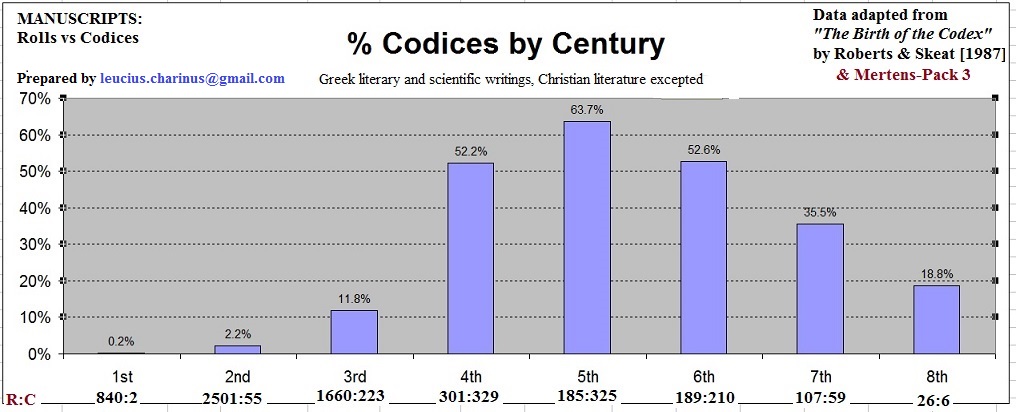
From a review of Lionel Casson's Libraries in the Ancient World the author provides some statistics regarding the appearance of codices and the transition in the ancient world from the technology of rolls to the technology of codices. The following statistics are cited:
b) the (palaeographic) dating for the early Christian manuscripts is wrong, and that they are really all from the 4th century.
| century |
papyrus rolls [R&S] |
codices pap + parch |
TOTAL |
% rolls* [R&S] |
% codices* [R&S] |
other |
| 1st |
0840 [252] |
002+000 [001] |
0887 [253] |
94.7 [100] |
00.2 [00] |
|
| 1/2 |
[203] |
[004] |
[207] |
[98] |
[02] |
|
| 2nd |
2501 [857] |
051+004 [014] |
2677 [871] |
93.4 [98½] |
02.1 [01½] | |
| 2/3 |
[349] |
[017] |
[366] |
[95½] | [04½] | |
| 3rd |
1660 [406] |
196+027 [093] |
1992 [499] |
83.3 [81½] | 11.2 [18½] | |
| 3/4 |
[054] |
[050] |
[104] |
[52] |
[48] |
|
| 4th |
0301 [036] |
231+098 [099] |
0738 [135] |
40.8 [26½] | 44.6 [73½] | |
| 4/5 |
[007] |
[068] |
[075] |
[09½] | [90½] | |
| 5th |
0185 [011] |
229+096 [088] |
0602 [099] |
30.7 [11] |
54.0 [89] |
|
| 6th |
0189 |
166+044 |
0487 |
38.8 |
43.1 |
|
| 7th |
0107 |
042+017 |
0238 |
44.9 |
24.8 |
|
| 8th |
0026 |
004+002 |
0050 |
52 |
12.0 |
Diagramatic Summary
DATA adapted from "The Birth of the Codex" by Roberts & Skeat [1987] and Mertens-Pack 3.
The Comparanda are all taken from "Common Empire Scribes" |
|---|
If scholars are using other fragments of writings from the early centuries to serve as benchmarks for the dating of the handwriting, is not the assumption that the collection of scribes' handwriting were somehow all representative of their century and station in the milieu. The comparanda include all sorts of common documents, prepared by common people who were scribes of the common and everyday empire. In contrast, the "christian" people who were supposedly copying the new testament texts were some form of secret society, underground and out of sight - to all intents and purposes some form of insular and separated group. We might assume they did not "subcontract" their NT copying to the common scribes of the empire. This suggests that the principles of comparanda (used to date the fragments by comparing scribal handwriting) might be stretched to the limit. The New Testament scribes were not the common everyday scribes in the empire.
The Appearance of Crosses + on Oxyrhynchus Papyri |
|---|
A search for these types of decorative crossed among letters from Oxyrhynchus reveals
that they can be found in an additional ninety-six letters. [76] In each case the cross
that is empoyed roughly resembles the Greek cross and it mostly appears in the left margin at either the begiing of the end of the letter. [77] Yet the cross symbol does not
begin to appear in any letter until at least the mid to late fourth century, [78] after
which it gradually gains in popularity and by the 6th and 7th century appears on almost every letter. [79]
[75] In certain types of documents, mostly orders of arrest, crosses resembling the form
of the St. Andrew's cross (X) appear near the bottom to prevent any unauthorised additions:
P.Oxy.XXXI 2576.4-5
P.Oxy.XLIII 3130.4
P.Oxy LXI 4115.4
[76] List of these letters at Table 4 in appendix
[77] The Latin cross (crux ordinaria), where the vertical stroke is noticeably longer
that the horizontal is not attested.
[78] Earliest letter with cross is P.Oxy.LVI 3862.
The Typology of the Early Codex: Eric G. Turner |
|---|
Eric G. Turner opens his book "The Typology of the Early Codex" with the statement that "The greatest benefactors of mankind are unsung and unknown - the inventor of the wheel, the deviser of the alphabet. Among their number we should place the inventor of the codex." The opening paragraph then continues to elaborate on the advantages of the codex and the disadvantages of the roll. There is nothing here to contradict. Three cheers for the "unsung and unknown"!!!However, in the second paragraph, the author states ...
"Let me be quite clear. I do not mean to reopen the question of the origin of the codex. C.H. Roberts in his British Academy paper on "The Codex" of 1954 has set out a series of attractive hypotheses which are likely to hold the field until new evidence is forthcoming.. Pointing to the fact that almost all Christian texts found in Egypt (beginning in the second century of the Christian era) are in codex, not roll form, at a time when parallel finds from the same source show that the codex form was scarcely used at all for Greek and Latin literature, he has suggested that the codex was a deliberate innovation of Christian evangelists, who evolved it from the parchment notebook."
p.2 "The somewhat hit-and-miss datings assigned by palaeographers to books on the basis of their handwriting". Every palaeographer is aware of his fallibility on this score. The person without palaeographical skills will have observed with interest a number of recent examples of incompatible dates. 1) Different editors of separated fragments P.Oslo ii 10 and P. Harris 45 later determined to be from the same ms dated 3rd century and 1st century. Both could not be right! 2) Same editor (Sir Frederick Kenyon) dated different fragments of same ms to late 3rd and early 3rd centuries. Both could not be right! 3) P.Oxy 2105: Hunt (1927) = edict of a prefect - Petronius Honoratus, prefect in 148 CE. P.Oxy 2105: Rea (1967) = edict of prefect - Maevius Honoratianus, prefect in 231-236 CE. This example is especially instructive since it is the error of an outstanding palaeographer; and concerns a documentary hand, a type of writing which it is often claimed is easier to date with confidence that a book hand. The helplessness felt by palaeographers when they have to rely on the morphological analysis of letter forms is well illustrated by the lack of agreement on the dating of the Ambrosian Iliad, and more recently of the Duke University fragments of Plato Parmenides 253. I cannot bring myself to date this fragment in the 2nd century, as Professor W.H. Willis does, and throughout this study I have treated it as 3rd-4th century. Other palaeographers ... assign it to the 6th century. /// ... it is easy to see how circularity has distorted the truth in the past. Just because the "communis opinio"down to the 1930's was that the codex was late in invention and acceptance, not really at home till the 4th century after Christ, papyrologists tended to give late dates to papyrus manuscripts on codex form. Then in the 1930's the growing mass of material, the analsys of the Rylands Library of St.John (P 52) by CH Roberst and of the British Museum "Unknown Gospel" (NT Apoc 7) by HI Bell and TC Skeat, and above all the publication by Sir Frederick Kenyon of the Chester Beatty Codices (esp. Codex VI) offered a solid base for the view that the codex was well established for Christian writings in the 2nd century and for Greek literature in the 3rd. Earlier datings were revised, and codices were allowed to be older than their first editors had suggested. This reaction has really gained momentum in the 1950's and 1960's and has in my view now gone a great deal too far. I have already quoted the case of Ch.B Biblical Codices IX and X: of the alternative dates proposed for these (either early 3rd or end of the 3rd century) the later one seems to me to come nearer the truth. Similarly, Bodmer P II, a codex of St John in a relatively small square format dated by its first editor to about 200 CE has been placed in the middle of the 2nd century by Professor H Hunger. I have elsewhere given palaeographical reasons for thinking this redating wrong, and that the better placing is to c.200-250 CE; as I have for Bodmer Papyrus IV (and XXV, XXVI), the Mendander Codex, not to the early or middle part of the 3rd century, but to about 300 CE or even to the early 4th century. /// Is the [valid] objection of circularity, then, to deter us from attempting our task at all? A moment's reflection on the instance just given will show that this "circularity" is complex: it is not a matter of simple opposition between an independent date for handwriting on one side and the resultant date for a codex on the other. In the dating of a papyrus manuscript by a scholar a large number of elements are taken into account. .... The rigorous palaeographer will try to derive each single element from a certainly dated source. But the quantity of certain data is in fact insufficient for his needs. The certain dates have to be linked to each other by extrapolation, by hypothetical extension and combination: however conscientiously the palaeographer tests out and refines his apparatus of criteria, it is unlikely that he will succeed in eliminating a subjective factor ....
Sacred Scriptures as Trash: Biblical Papyri from Oxyrhynchus |
|---|
Most New Testament papyri with a known provenance were found at the site of the ancient
Egyptian city of Oxyrhynchus, or more precisely: on that city’s rubbish mounds. The fact
that sacred scriptures were discarded as garbage is surprising in view of the holiness
of Christian biblical manuscripts, intrinsically and physically. Yet the trash aspect of
provenance has never been adequately problematized or studied. Taking a social-historical
and garbological approach, this article demonstrates that at Oxyrhynchus in antiquity
entire manuscripts with biblical writings were deliberately discarded by Christians
themselves, unrelated to persecution and issues of canonicity.
NOTES:
p.222
Writing around the year 400, the author of the Historia monachorum in Aegypto
describes Oxyrhynchus in idealized terms as a fully orthodox Christian city. [17]
But the religious milieu at Oxyrhynchus was much more diverse.
Besides “pagans and heretics,” such as Manichaeans, papyri found
at the site reveal also a Jewish community. [18]
[17] “... since the city is large, it has twelve churches where the people assemble.
As for the monks, they have their own oratories in each monastery. The monks were
almost in a majority over the secular inhabitants. In fact there are said to be
five thousand monks within the walls and as many again outside, and there is no
hour of the day or night when they do not offer acts of worship to God. Moreover,
not one of the city’s inhabitants is a heretic or a pagan (αἱρετικὸς οὐδὲ ἐθνικός).
On the contrary, all the citizens as a body are believers and catechumens (πιστοὶ καὶ
κατηχούμενοι), so that the bishop is able to bless the people publicly in the street.”
p.224
Peter Parsons described the situation:
“The town dumps of ancient Oxyrhynchus remained intact right up to
the late nineteenth century. They didn’t look exciting, just a series
of mounds covered with drifting sand. But they offered ideal conditions
for preservation. In this part of Egypt it never rains; perishables
which are above the reach of ground water will survive.
... sources indicate that the copies of early Christian and other texts
were discovered between broken potsherds and straw, and had been discarded
together with such objects as terracotta lamps, pens, pieces of glass, keys,
silverware, combs, hairpins, toys, textiles, woolen socks, broken sandals
and dice. [32] They apparently found so many dice, that Grenfell, jokingly,
came to the sociological conclusion that the Oxyrhynchites had been
“inveterate gamblers.”
p.227
Garbage mounds, built up over the course of centuries, encircled ancient cities
and could reach heights of 20 or 30 meters; [36] so also at Oxyrhynchus.
Waste Paper City by P. J. Parsons
Reproduced by permission of Omnibus; abridged by Gideon Nisbet, 1997.
Once it had walls three miles round, with five or more gates; colonnaded streets,
each a mile long, crossing in a central square; a theatre with seating for eleven
thousand people; a grand temple of Serapis. On the east were quays; on the west,
the road led up to the desert and the camel-routes to the Oases and to Libya. All
around lay small farms and orchards, irrigated by the annual flood — and between
country and town, a circle of dumps where the rubbish piled up. The citizens of
this county town, five days journey by road (ten by water) south of Memphis,
called it Oxyrhynchus, or Oxyrhynchon polis, ‘City of the Sharp-nosed Fish’.
p.232
Christians considered their writings sacred — not just the content but also the
physical manuscripts — becomes clear through an examination of three different areas:
literary sources, iconography of books, and archaeological contexts of other manuscript
finds.
The importance of the physical codex as the embodiment of Christ even resulted in its
enthronement — literally — at church councils. The earliest firm evidence for this
practice comes from the Council of Ephesus, held in 431, where the participants gathered
“in the holy and great church which is called Mary, with the holy gospel exposed on the
throne in the very middle, and displaying Christ himself present with us."
p.235
The enthronement of the gospel book inspired artists as it became a frequent
iconographical theme. The late-fourth/early fifth-century dome mosaics in the
Rotunda in Thessaloniki depict “jeweled books on pillowed thrones,” [62] and
a bronze relief in the Hagia Sophia in Constantinople shows a throne with an
opened codex upon which a dove descends. [63]
[62] Laura Nasrallah, “Empire and Apocalypse in Thessaloniki: Interpreting the
Early Christian Rotunda,” JECS 13 (2005) 465-508 at 485.
[63] See Wenzel, “Die Schrift und das Heilige,” 33 and 34, Abb. 18. Such images
of the throne are called the hetoimasia (preparation). As Annemarie Weyl
Carr stated, “Initially, in the 5th-7th C., the image signifies not the empty
throne awaiting God, but—in accord with antique use of the throne to represent
the presence of a god or emperor—God’s mystic presence upon the throne”
(Annemarie Weyl Carr, “Hetoimasia,” in The Oxford Dictionary of Byzantium
[ed. Alexander P. Kazhdan; Oxford: Oxford University Press, 1991; e-reference
edition 2005, accessed through Princeton University, 7 January 2009]).
Surveying the archaeological provenance of early Christian manuscripts, I found
that a good number of them had been buried, alone, with other writings, or with
deceased people. [68] Such burial practices indicate the value — religious,
economic, personal — associated with these manuscripts. The burial of used-up
sacred manuscripts evokes a practice reflected upon more systematically in
rabbinic Jewish circles regarding the genizah, or storage room ...
1886-7 at Akhmim (ancient Panopolis) in Egypt a codex with sections of the Gospel and
Apocalypse of Peter, 1 Enoch and the Martyrdom of Julian Anazarbus (P.Cair. 10759)
accompanied a person in the grave. [76]
Jewish sages were often buried with books, [77] and Greeks likewise gave manuscripts
as grave goods. [78] In traditional Egyptian religion, the deceased needed a copy of
the Book of the Dead for reference and perhaps we should interpret later finds of
books in graves as a continuation of that practice.
p.240
These examples from the literary and material world suffice here to illustrate the
reverence for Christian books as sacred objects, which sharply contrast the disposal
witnessed at Oxyrhynchus to which I now return. First, I will discuss several
inadequate explanations for this striking fact and then I will offer my assessment
of the situation.
If, as we have seen, Christians hold their manuscripts in such high regard, how then
should we explain the fact that their manuscripts ended up on city garbage heaps?
The disposal of manuscripts as trash happened not only in the earliest centuries of
our era, ... but the presence of manuscripts that date to the fourth, fifth, and sixth
centuries found also at the Oxyrhynchite rubbish mounds means that they were copied and
discarded after the persecution. What we have here is thus a continuous practice.
p.244
An examination of the find from Oxyrhynchus, however, implies that in multiple cases
large portions of manuscripts or even entire manuscripts had been discarded. These
manuscripts either deteriorated (further) on the trash heap, which may explain their
present fragmentary state, or they had been torn up before they were discarded.
Indeed, in their archaeological reports, Grenfell and Hunt indicated repeatedly that
manuscripts had been torn to pieces. [95]
[95] “Before being condemned to the rubbish-heap, the papyri had, as usual, been torn up.”
(Grenfell and Hunt, “Excavations at Oxyrhynchus: Fifth Season [1905-6],” 361).
Grenfell and Hunt on the Dates on Early Christian Codices |
|---|
Since the middle of the twentieth century, there has been a tendency among scholars
to marginalize the palaeographical opinions of Grenfell and Hunt. Their alleged belief
that the codex format was a post-third century development is said to have induced them
to date fragments of Christian codices much later than they would have on strictly palaeographical
grounds. I argue that this is a serious misrepresentation of their views and practices.
NOTES:
P64 ... Hunt "assigns with more probability to the fourth century.”
P15 and P16 ... "Grenfell and Hunt dated these fragments to the fourth century"
"it may be remarked that in 1904, when Part IV of the Oxyrhynchus Papyri appeared,
Christian texts which could confidently be dated in the second century were unknown."
p.155
In his report of the first season’s excavations (1896/7), Grenfell writes:
I had for some time felt that one of the most promising sites in Egypt for finding
Greek manuscripts was the city of Oxyrhynchus. ... Above all, Oxyrhynchus seemed to
be a site where fragments of Christian literature might be expected of an earlier date
than the fourth century, to which our oldest manuscripts of the New Testament belong;
for the place was renowned in the fourth and fifth centuries on account of the number
of its churches and monasteries, and the rapid spread of Christianity about Oxyrhynchus,
as soon as the new religion was officially recognized, implied that it had already taken
a strong hold during the preceding centuries of persecution.
Oxy. vi 849 = NT Apocrypha 13, is dated to c. iv rather than c. iii because it is on parchment.
“Had the material been papyrus we should have been more disposed to assign it to
late c. iii rather than to c. iv.”
1007 = OT 2 (Latin Genesis on parchment): The same reason is given in regard to vii 1007 = OT 2,
because the material is parchment.
p.160
It seems assured, then, that at least as early as 1899, Grenfell and Hunt recognized
that the received wisdom with regard to the development of the papyrus codex was in need
of revision. Indeed, they stressed the preponderance of examples of Christian codices
in the third century, and they recognized an early Christian preference for the codex.
Conclusion
From nearly the very beginning of their publication of the Oxyrhynchus papyri, Grenfell and Hunt
recognized that Christians were well established in Oxyrhynchus in the third century and that the
codex was an early development among Christians in Egypt. The claim that they thought otherwise
and that this thinking influenced them to date fragments of Christian codices later than they
would have on strictly palaeographical grounds has no basis. The preceding review of the
scholarship demonstrates that the criticism of Grenfell and Hunt by Roberts, Bell, and Skeat is
without merit, and the grosser forms of the claims against Grenfell and Hunt founnd in the
subsequent writings of some biblical scholars should be disregarded. Grenfell and Hunt saw, read,
and edited thousands of papyri. Their palaeographical opinions involving Christian codices have
been unfairly marginalized, and the modern student who ignores their judgements does so to his or
her own detriment.
Early New Testament Manuscripts and Their Dates: A Critique of Theological Palaeography |
P# Authors [Alt-Date] Source Early? Grenfell/Hunt Date?
P30 175-225 [275-350] 1st Edn
P45 200-250 [200-300] Comfort
P46 200-225 [200-250] 1st Edn P46
P52 125-175 **** P52
P64+P67+P4 175-200 [P4:300-400] 1st Edn 4th century
P66 200-250 **** P66
P75 200-250 **** P75
P87 200-250 [200-300] Nestle-Aland
P90 150-200 **** P90
P95 200-225 [200-300] Nestle-Aland
P98 200-250 **** P98
P104 100-200 **** P104
0171 175-225 [300-350] Nestle-Aland
0212 175-225 [200-300] Nestle-Aland
______________________________________________________________________________________
TOTAL: 007 papyri
The Limits of Palaeographic Dating of Literary Papyri ... |
|---|
Palaeographic estimates of the date of P.Bodmer II, the well-preserved Greek papyrus codex of the Gospel of John, have ranged from the early second century to the first half of the third century. There are, however, equally con- vincing palaeographic parallels among papyri securely dated to as late as the fourth century. This article surveys the palaeographic evidence and argues that the range of possible dates assigned to P.Bodmer II on the basis of palaeography needs to be broadened to include the fourth century. Furthermore, a serious con- sideration of a date at the later end of that broadened spectrum of palaeographic possibilities helps to explain both the place of P.Bodmer lI in relation to other Bodmer papyri and several aspects of the codicology of P.Bodmer II.
NOTES:
p.19/20
.... Such a wide span is perfectly reasonable, and this point needs to be emphasized.
We should not be assigning narrow dates to literary papyri strictly on the basis of
palaeography. Four kinds of evidence support this contention -
1. The first type of evidence comes in the form of papyri that demonstrate at least
some scribes were capable of writing in multiple different styles generally assigned
to different time periods. P.Oxy. 31.2604 provides an example, in which a scribe puts
on a show of skills by copying the same poetic line in different styles, twice in a
narrowly spaced hand at home in the third century and once in a spacious uncial typical
of the first century.
2 The second type of evidence is the phenomenon sometimes called "archaism". [36]
The classic case is P.Oxy. 50.3529, a papyrus scrap written in a textbook example of a
first century Roman hand. The editor of P.Oxy. 50.3529 noted its palaeographic affinities
with the hand of P.Oxy. 2.246, a registration of livestock dated to the year 66 CE.
P.Oxy. 50.3529 is, however, a copy of the Martyrdom of Dioscorus, so this writing can be
no earlier than the year 307 CE. The span for this hand is therefore at least two and a
half centuries
3. Third, the active working life of a scribe could be remarkably long. Revel Coles has
suggested that the same scribe could be responsible for copying parts of P.Oxy. 64.4441
(315 CE) and P.Oxy. 67.4611 (363 CE), which "would result in a working life not less than
49 years". [37]
4. Finally, similarities in hands were passed from teachers to students, so that a given hand
could last through multiple generations. [38]
All of these factors suggest that we should be very wary of assigning palaeographic dates
within narrow margins (and we should certainly end the highly dubious practice of palaeographically
dating pieces "circa" a particular year). [39] A reasonable palaeographic date range for P.Bodmer lI
would be mid-second to mid-fourth century. [40].
Extract from Milne's 'A History of Roman Egypt' |
|---|
A HISTORY OF EGYPT ROMAN EGYPT CHAPTER I THE ORGANISATION OF EGYPT UNDER THE ROMANS THE conquest of Egypt by the Romans produced little change In the internal organisation of the country. It was always the policy of Roman statesmen, when a country possessing" a fully developed system of govern- ment was added to their empire, to interfere as little as possible with existing institutions ; and there was a special reason in the case of Egypt for adopting this course. The country was, In a sense, the personal spoil of Augustus ; while the older provinces of the Roman Empire had been won from foreign kings for the Republic by its generals and with Its armies, Egypt was the fruit of his victory over a Roman rival, albeit a recreant to Roman ideas ; and, as the personal pro- perty of that rival's wife, was confiscated for the private benefit of the victor. 2. The elaborate system of government which had gradually been developed by the native and Greek kings was therefore taken over bodily by the Roman emperors. In all probability the lower grades of officials were left to complete their terms of office : even in so high a position as that of epistrategos there is found a Greek, Ptolemaios, the son of Henikleides, thirteen years after the conquest ; W and as in later times that post was always held by a Roman, it may be presumed that he had continued in his place undis- turbed by the change of dynasty. For, indeed, the Roman conquest of Egypt was practically nothing more than a change of dynasty, and was attended by far less disturbance than had many times been caused by the transference of power In the time of the native kings, 3. In the course which Augustus chose to follow with regard to the government of Egypt, he was guided partly by his personal claim explained above, and partly by considerations of prudence : ^ the country was rich, and could easily furnish the materials for supporting a revolt ; while, at the same time, anyone who held Egypt could cause great inconvenience to the population of Rome without any further hostile measures than simply stopping the export of corn from Alexandria, and could thus practically starve Rome to his side, as Vespasian proposed to do.^ More- over, Egypt was difficult of access, especially from Rome : there was only one harbour on the Mediter- ranean coast available for large vessels, at Alexandria ;^ and the approaches by land across the deserts, either from east or west, were dangerous for a body of any large number of men. The Egyptians, too, were always ready for a disturbance ; the most trivial question would raise faction-fights among the crowds of various nations and beliefs who inhabited Alex- andria/ 5 ) while the inhabitants of the upper country from time to time took up arms to settle their local grievances ; < (i ) and from such small beginnings there might arise serious troubles, unless prompt and vigorous measures were taken. In all these reasons lay a great argument for autocratic rule, which could act on such an occasion without the danger of delay which might arise from the necessity of consulting the senate, purely formal as the consultation might be, to get con- sent to measures which seemed good to the emperor. 4. Egypt was therefore treated as the personal domain of the Roman emperor ; and from him, directly or indirectly, all the Egyptian officials held their posts. To guard against any possibility of senatorial inter- ference, no member of the senate was allowed to take office, or even to set foot, without the special leave of the emperor, in the country/ 7 ) The highest position that of prefect was usually filled by a Roman of equestrian rank ; < 8 > on one occasion at least a freed- man/ 9 ) and on one an Alexandrian/ 10 ) who had obtained the Roman citizenship, were placed in this office. 'The prefect, nominally a procurator of the emperor, was really a viceroy, taking" almost the whole part played in the system of government by the Greek kings. His power was limited only by the right of appeal to the emperor ; and he was head of every branch of the administration, financial, judicial, and military/ 11 ) The sum -total that was to be raised by taxation was determined by the emperor ; but the prefect was re- sponsible to him for the collection and transmission of the money to Rome/ 1 -) and consequently was par- ticularly concerned to supervise the collectors and other subordinate officials, with a view of keeping in check their exactions, which tended to diminish the revenues of the state ; ( 13 > and also had to decide upon claims of exemption from taxation made by commun- ities or individuals/ 11 ) The judicial duties of the prefect, which theoretically embraced all cases, both civil and criminal, were lightened by the .delegation of authority to lower officials;^ 5 ) but large numbers of legal questions came before him for settlement, as petitions for the redress of injuries could be addressed directly to him/ 1 *') and he received appeals or references from the inferior courts/ 17 ) He went on circuit throughout the country, probably every year, to try such causes/ 18 ) He was also specially concerned to inquire into the efficiency of the police of the various districts/ 19 ) The nominations to subordinate offices and liturgies, and appeals against them, also came before him;( 2 ) and from him emanated the orders for official inquiries and returns, such as the census lists of persons and property of all kinds which were constantly required, and for the safe keeping of these and other records/- 1 ) All the troops in Egypt were under his control, and their complaints and disputes were specially referred to him for decision/ 2 -) He held office at the will of the emperor, and was not, apparently, appointed for any definite period ; C 23 > the longest recorded tenure of the office being that of Vitrasius Pollio, who was in Egypt for upwards of sixteen years : W and he was assisted by a council of Romans, who sat in the prsetorium/ 25 )