 |
|---|
 |
Dear Arius
Constantine's "Dear Arius" Letter (333 CE)
A Political Analysis, P.R.F. Brown, 2008 CE
|
|---|
|
|---|
|
|---|

A Political Analysis of a Nasty Letter |
|---|
Also see ... 2009 Updated Analysis of this Letter
LETTER: Emperor Constantine to Arius
Type:   Early Arian Document (Urkunde) 34 (=AW III2 no. 27; CPG 2042)
Date:   333 CE
Source: Athanasius, Defense of the Nicene Definition 40 (TLG)
        Also found in Socrates, Church History 1.9.30
        and Gelasius, Church History 3.19.1
Trans:  Coleman-Norton, P.R.,
        Roman State and Christian Church, London:
        Society for Promoting Christian Knowledge
       (SPCK) 1966, #67.
|
Introduction
Here follows one translation of the above letter recognised
to have been authored by Constantine about the year 333 CE.
We learn here
that Arius was an ascetic priest, who had a great following
particularly in Syria, where Constantine "thinks he maybe".
Arius is on the run. He had left his mark on the council of
Nicaea by remaining silent, and inconspicuous, but at the
same time, articulating a number of simple dogmatic assertions
which are preserved in the Nicaean "Oath".
Since that time, Constantine informs us that Arius has been
highly resourceful and industrious, and has authored biting
anti-Constantinian (anti-Christian) polemic, in verse, which
enjoyed much popular support.
Arius is abused by Constantine, from one end of the letter
to the other. Arius was the focal point of whatever fourth
century resistance was offered against the implementation
of Constantine's political and religious initiatives.
Recommended background reading, for interested parties,
should include Constantine and the Problem of Anti-Pagan
Legislation in the Fourth Century, Scott Bradbury,
Classical Philology, Vol. 89, No. 2 (Apr., 1994),
pp. 120-139, and the older, summary paper, Constantine's Prohibition
of Pagan Sacrifice, T. D. Barnes, The American Journal of
Philology, Vol. 105, No. 1 (Spring, 1984), pp. 69-72. See this list of external papers.
In his book Arius: Heresy and Tradition, Rowan Williams
describes this letter of Constantine as
"extraordinary in its venom and abusiveness",
dubbing Arius as "Ares, a god of war.
Constantine refutes Arius' theology and
"turns to sneering at Arius' wasted
and ascetic appearance."
The text of the letter follows, variously interspersed with
editorial commentary related to the political issues being
disclosed by the Emperor Constantine, who is best considered
as a supreme imperial mafia thug, malevolent despot, and
military supremacist. Arius is presented as an ascetic.
It is a very uneven battle.
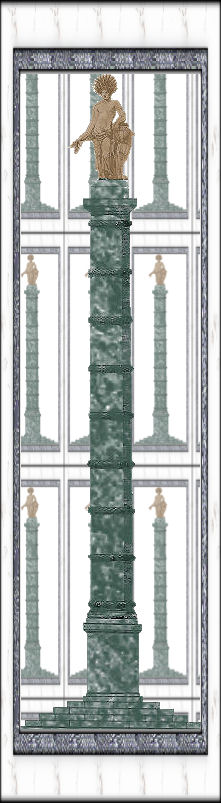
Constantine's Column [Left]:
Provided to gain perspective on the very uneven battle between
the successful military supremacist Constantine and the ascetic
priest and logician, Arius of Alexandria, is the Column of
Constantine (shown left).It could have been easily seen from
the Sea of Marmara and the Bosphorus, and was completed at
the dedication of "The City of Constantine", 11 May 330.
It was constructed of nine drums of porphyry each 2.9 m
in diameter, topped by a Corinth Capital. Its total height
was more than thirty-six meters. The column was crowned with
colossal bronze statue of Constantine, depicted wearing a
crown of seven rays. (It may have been Pheidas' sculpture
of Apollo Paropius from the Acropolis of Athens, recycled
with bullneck's head. Some accounts describe Constantine
holding a spear in the left hand, and a globe in the right
hand. Data from The Emperor Constantine, by Hans A. Pohlsander.
Historian John Julius Norwich writes that in the Column of Constantine, “Apollo, Sol Invictus and Jesus Christ all seem subordinated to a new supreme being—the Emperor Constantine.”
When "The Boss" writes the following letter to Arius, this column
has already been standing in "The City of Constantine" for some
years. Enormously successful and despotic military man Constantine,
and small wise and clever ascetic man Arius.
|
Constantine Augustus
to Arius
and to Arians.
(1.) A wicked interpreter is really an image and a statue of the Devil.
For as skilled sculptors mould him for an incitement to deception,
as if cunningly contriving a goodly appearance of beauty for him,
who by nature is absolutely most base, that he may destroy
miserable persons by offering error to them, in the same way, I think,
must act this fellow, to whom only this appears to be worthy of zeal:
namely, to proffer profusely the poisons of his own effrontery.
Constantine is mad at Arius
Constantine is claiming that Arius proffers
profusely the poisons of his own effrontery.
The Boss must have been really mad with Arius.
What was Constantine's problem with Arius?
What had Arius done to rile up the Boss?
We are about to find out.
|
(2.) Therefore he introduces a belief of unbelief –
new and never yet at any time seen since men have been born.
Wherefore truly that does not seem at variance from the truth,
which long ago was described distinctly by the divine saying:
 “They are trusty for evil.”
Arius's Unbelief
Arius is associated with "a belief of unbelief":
"He introduced a belief of unbelief –
new and never yet at any time seen
since men have been born."
What do we know Arius to have said at Nicaea?
Just these things alone and dogmatically.
Just these five assertions - he was quiet and dogmatic.
- "There was time when He was not.
- Before He was born He was not.
- He was made out of nothing existing.
- He is/was from another subsistence/substance.
- He is subject to alteration or change."
Arius' introduced a belief of unbelief
against the propaganda of Constantine.
He did not believe in "New Testament Authenticity".
He did not believe the Canonical texts were divine.
He authored biting anti-christian polemic.
Constantine was pissed off at Arius for publishing his unbelief.
Arius unbelief, I believe, was focused on the Constantine Bible.
The words of Arius above, are historical commentary on Jesus.
- Before Constantine - There was time when He was not.
- Before Constantine - Before He was born He was not.
- He is fictitious - was made out of nothing existing.
- He is a fiction - from another subsistence/substance.
- The fiction - is subject to alteration or change."
|
(3.) For why can anyone say this:
that he who no longer desires to find any aid for alleviation
has lost the grace of taking advice?
Why, then, do I say: “Christ, Christ, Lord, Lord!”?

Why in the world do bandits injure us daily?
A certain harsh and violent audacity stands before us;
it roars, gnashing its teeth, deformed by dishonor,
and wounded by manifold accusations.
Constantine's "Christ", "Lord", and "injuries"
Constantine deals in "Christ, Lord, and injuries".
He was a military supremacist and malevolent despot.
Constantine is described by Aurelius Victor as
"a brigand and a ward irresponsible for his own actions". |
(4.) Of course, it, just as if scattered
by certain storms and waves of evils,
in the law and the proclamation about you
vomits pernicious words and in writing produces these,
which you, who do not at all coexist
with the Eternal Father of your origin,
have defined by cognition about yourself.

In short, it collects and gathers
certain terrible and lawless impieties,
now indeed agitating tongues, now again
uplifted by enthusiasm for miserable persons,
whom, when present for security,
it deceives and destroys.
Arius' writings are "pernicious".
Constantine discloses that Arius' writings are "pernicious".
Arius is a focal point for anti-Constantinian propaganda.
Arius may have written some satires or parodies.
Perhaps he wrote "TAOPATTA?
Perhaps he wrote "The Acts of Philip?
We know he wrote "Thalia" and "The Songs of Arius".
But what were these? They are lost to us. Or are they?
The writings were anti-christian polemic. |
(5.) But now I wish to examine
the character of its chief proponent.
For what says he? He says,

      “Either let us hold that, of which already
       we have been made possessors,
       or let it be done, just as we ourselves desire.”

He has fallen and in these matters he has fallen dead;
he says: “By treachery or cleverness of knavery” –
it makes no difference.

He considers holy only what has crept
into him through base thought.
He says: “We have the masses.”
Constantine's treachery and clever knavery
Constantine discloses that Arius wants to hold on.
Hold on to what? Probably the old Hellenic temple traditions.
Constantine had PROHIBITED temple sacrifice already c.324 CE.
He had in 324/325 CE raised to the ground various temples.
Specifically the temple of Asclepius, at Aegae.
He had ordered the head priests (ie: physicians) executed.
What does Constantine report that Arius says?
“Either let us hold that, of which already
we have been made possessors,
or let it be done, just as we ourselves desire.”
Constantine discloses that Arius uses the terms
“By treachery or cleverness of knavery”.
What would Arius be describing, in Constantine's actions?
Could it be the same thing articulated by Emporor Julian c.362 CE:
Constantine remains unconcerned that Arius present the majority.
His reference to "We have the masses" indicate despotic intent.
Constantine had the command of the army.
His army had "liberated" Rome in 312 CE.
His army had "liberated" the Eastern empire 324 CE.
But there was resistance to Constantine's agenda.
|
(6.) Indeed, I myself shall advance a little farther,
that I may become a spectator of those wars of insanity.
I myself, I said, shall advance, I who have been
accustomed to end wars of senseless men.

Come now Ares Arius,? there is need for shields.
Do not do this, we beg; at least, then,
let Aphrodite’s intercourse detain you.

But really, would that, as you seem to fashion
the finest things for the masses, so it would be
our part to abound in piety toward Christ!
Arius as "Ares" - God of War.
Constantine calls Arius "Ares" - God of War.
But Constantine refers to himself as "Accustomed to end wars".
He is referring to his last two or three decades of military supremacy.
For the period 305 to 333 (28 years) he had been undefeated.
He then discloses again that Arius "fashions the finest things for the masses". These are the wonderful and popular texts that Arius has authored.
Constantine wants his new christ written in to Arius' works.
He understands that Arius is the focal point of resistance.
He is impressed by Arius' clever writing, but he is stinging
because the polemic is being directed against christainity.
Arius does not belief in it. He is resisting Constantine's "Christ".
|
(7.) Look, I come again as a suppliant and,
though powerful in weapons in respect to the whole populace,
I do not wish to fight; but fortified by Christ’s faith,
I desire you both to be cured and to heal others.
Constantine controls the populace by the sword
Constantine edges up "as a suppliant".
He admits he is "powerful in weapons in respect to the whole populace".
He discloses that he has a systematic military mind.
He want Arius to be "healed and to heal others"
but in the name of Christ.
It is likely that Arius was already part of a physician's cult.
It may have been the "physicians of the souls" of the Healer Asclepius/Imhotep.
It may have been in association to a similar ancient cult.
Arius was an ascetic priest. Constantine wants Arius to defect
to his new christian brotherhood. |
(8.) Why, therefore, do you say
that you do these things,
which befit not your character?
But with what peace, tell me,
or encompassed with what abundance,
but rather, advanced with what rashness?

Oh, audacity worthy to be destroyed by thunderbolts!
For hear what he, writing with a pen distilling poison,
recently has explained to me. He says:

           “Thus we believe.”

Then I suppose, having added
I know not what certain things
somehow swaggeringly and quite accurately elaborated,
he, going farther, left unsaid nothing at all of bitterness,
but he opened the whole – as someone may say –
treasury of madness. He says:

            “We are expelled
             and they take from us
             permission to be admitted.”
"THUS" Arius believes ...
Constantine is confronted by ancient belief and opinion.
"Thus we believe" says Arius, the opponent to Constantine.
Constantine discloses that Arius considers himself "expelled"
from the temples of the empire.
This indicates Constantine's prohibition of "temple use" was effective.
He had military control over his new legalisation of "temple use".
The major temples and shrines of cults of the eastern empire
had been "locked up" by decree, and their use prohibited.
Arius takes this personally - but he is an ascetic priest.
Arius is a logician, wise and clever in disputation.
If you must, perhaps Arius is an ancient Mahatma Ghandi.
The traditional lands had been locked up by a malevolent despot. |
(9.) But this is not at all
apposite to the matter;
turn your mind to what follows,
for I shall use his words.
He says:

      “We ask that, if the bishop of Alexandria
       remains in the same opinion,  hereafter
       it be granted to us –
       according to the law’s arrangement -
       to celebrate the lawful and indispensable
       services to God.”
Request to preserve tradition?
Arius asks that the ancient traditions be preserved.
Constantine takes personal offence to this suggestion.
After all, who was the Boss? |
(10.) Oh, terrible shamelessness,
which ought to be refuted thoroughly
by the zeal for truth!
For what has happened to please him,
this has been marked by conciseness of expression.
What do you say, foolish one?

Do you prepare to construct the disease
of your savage thought against me as a discord,
which is specious in our sight?

And do you hasten to destroy
the persons involved with you evil?
Constantine's Threats ...
Constantine threatens Arius' friends and associates. |
(11.)    "What, then,"
you say, “Shall I do,
         if none deems me
         worthy to be admitted?”

For this you often shout
from a profane throat.
But I shall speak against you:
Where have you shown a clear mark
and proof of your intelligence?

And this you ought to have disclosed
and to have established clearly for gods and men
- and especially when poisonous serpents
even then are by nature more savage,
when they know that they themselves
are found in recesses of dens.
"Let me in to the Temples", says Arius
Arius asks what shall he do if none deem him worthy
to be admitted to the ancient and collegiate network
of temples. But Constantine asks for Arius' academic
credentials. Constantine associates Arius and the "Serpent".
(Is this the serpent of Asclepius?)
The Boss does not like the snake. |
(12.) But that is indeed
quite urbane of him:
that quite eagerly,
just as if under
a certain mask of modesty,
he pretends silence.

You indeed show yourself
tame and submissive
by the artifice of pretence;
you escape the notice of many,
when you within are full
of countless evils and plots.

But, oh, wretchedness!
As the Devil has desired,
so he had made Arius
a manufactory of iniquity for us.
Arius is outwardly silent
Constantine discloses Arius outward mask of characteristics.
Arius is outwardly modest and silent - perhaps purposefully.
Arius appears to escape attention by his inconspicuous nature.
Arius was an ascetic priest (see further).
Constantine describes Arius as "a manufactory".
Arius was thus probably highly resourceful and industrious in his resistance. |
(13.) Advancing now, tell me
the mark of your faith
and indeed not at all be silent.

Oh, you possessor of a mouth perverted
and a nature quickly roused to wickedness!
“Do you talk of one God?”

You have me of the same opinion; think so.
Do you say that the

  “the Word of his essence
   is the Word without beginning
   and without end?”

I acquiesce in this;
believe so.
Arius was silent at Nicaea, but now?
Constantine is confronted by Arius' silent nature.
The Boss implores Arius to not be silent.
The situation is not dissimilar to The Story of Secundus the Philosopher.
Arius had been silent at Nicaea except for five dogmatic assertive phrases. The five phrases were ...
- "There was time when He was not.
- Before He was born He was not.
- He was made out of nothing existing.
- He is/was from another subsistence/substance.
- He is subject to alteration or change."
Perhaps this was all Arius could have said at Nicaea and keep his head?
Nevertheless, whatever Arius was thinking at Nicaea was unknown to the Boss.
Arius maintained silence over the fundamental issues.
His real thoughts however had probably now been explained to the Boss.
Constantine was mad.
Arius has a wicked nature and a perverted mouth.
What was Arius actually saying that caused Constantine so much grief?
Arius questioned the belief in the authenticity and integrity of Jesus Christ.
Were these questions related to the ancient historical record?
Arius has accused Constantine of "treachery or cleverness of knavery”
|
(14.) If you add anything further, this I abrogate.
If you join anything to an impious separation,
I confess that I neither see nor perceive this.

If you accept

     “the body’s lodging
      in respect to the administration
      of divine operations,”

I do not reject it.
If you say that

    “the spirit of eternity was born
     in the pre-eminent Word,”

I receive it.
Who has known the Father, unless he who comes from the Father?
Whom has the Father known, unless him whom he has begotten
from himself eternally and without beginning?
You think that you ought to substitute a “foreign hypostasis,”
believing doubtless badly; I know that the plentitude of the Fathers
and the Sons pre-eminent and all-pervading power is one substance.
Constantine's Divinity
Constantine talks about "the body's lodging" and the divine.
Arius is probably talking about "the embodied soul".
Constantine wants a more political outward divinity.
He starts getting technical with his theological terminology.
The Pontifex Maximus has designed to sponsor one specific divinity.
But did Constantine invent his divinity? This is the question. |
(15.) If, therefore, you detract from him,
from whom not yet ever anything
has been able to be separated
even by idle talkers’ process of thinking,
you pave the way for the marks of addition and,
in short, you determine the signs of inquiries for him,
to whom he had given entire eternity
for himself and uncorrupted intelligence
and his assigned belief in immortality
through both himself and the Church.

Discard then discard this silly transgression of the law,
you witty and sweet-voiced fellow, singing evil songs
for the unbelief of senseless persons.
Arius' resistance to the christian agenda
Constantine is confronted by Arius' resistance to the christian agenda.
Constantine's new Church is loud; the ancient Temples are silent.
They are silent by imperial decree, destruction and enforcement. |
(16.) Quite fittingly the Devil
has subverted you by his own wickedness;
and perhaps this seems pleasant to certain persons
(for thus you have persuaded yourself).
But it is in every way a destructive evil.

(17.) Come now, having departed from
your occupation with absurdities,
listen, good Arius, for I discourse with you.

Do you not understand that you have been
barred publicly from God’s church?
You are lost (be well assured),
unless, having regard for yourself,
you condemn your present folly.

But you will say that the masses act
with you and dispel your anxieties.
Arius' barred publicly from God’s church
Constantine bars Arius publicly from God’s church.
He is confronted by Arius' silent nature and
the support that rius has with the masses. |
(18.) Lend your ears and listen a little,
impious Arius, and understand your folly.
O God, protector of all, may you be well –
disposed to what is being said,
if it should admit of faith!

For I, your man, holding to your propitious providence,
from the very ancient Greek and Roman writing
shall demonstrate clearly Arius’ madness,
which has been prophesied and predicted
three thousand years ago by the Erythraean sibyl.
The Boss' PR Job: Authenticity of the Ancient Sibyl
Constantine is going to trott out the Erythraean sibyl.
This is part of his authenticity campaign.
He needs every bit that he can to put in front of the public.
Arius and the educated Greeks wont buy his authenticity by authority.
So he decides to ship some authenticity to Alexandria.
He talks of the Sibyl at the Council of Antioch.
The Boss literally shoots himself in the foot:
"Our people have compared the chronologies with great accuracy,
and the 'age' of the Sibyl's verses excludes the view
that they are a post-christian fake."
- Constantine's Oration, Antioch, 325 CE,
- to the (captive and non-christian) Saints
|
(19.) For she indeed says:

“Woe to you, Libya, situated in maritime regions,
for there shall come to you a time, in which
with the people and your daughters you must be compelled
to undergo a terrible and cruel and very difficult crisis,
from which a judgment both of faith and of piety
in respect to all persons will be given,
but you will decline to extreme ruin, for you have dared to engulf the receptacle
of celestial flowers and to mangle it with a bite
and you have polluted it with iron teeth.”

(20.) What then, knave? Where in the world
do you admit that you are now?
There, obviously; for I have your letters,
which you have scraped
with the pen of madness toward me,
in which you say that all the Libyan populace
is of the same opinion with you –
doubtless in regard to salvation.

But if you shall deny that this is so,
I now call God to witness that truly
I send to Alexandria –
that you may perish more quickly –
the Erythraean Sibyl’s
very ancient tablet,
composed in the Greek tongue.
Public Relations, Propaganda and the Erythraean sibyl
Constantine ships a relic to Alexandria in the publicity stakes.
He thinks this evidence is going to undo Arius.
Constantine discloses that he thinks Libia thinks the same way as Arius.
Constantine does not know where Arius is.
He'd certainly like to find Arius.
Perhaps he thinks by shipping the Sybil's tablet to Alexandria,
Arius will surface there, and can be trapped and captured.
Constantine is a malevolent despot who wants to change traditions.
He seeks out Arius with the intent to do harm,
because Arius is the focus of the "unbelief" and resistance to "christianity".
Arius wishes to retain the old salvation.
Constantine wishes to implement a new salvation.
Who was going to win out in the end?
Would the populace heed the authenticity of the Sybil?
Constantine threatens Arius with the gallows.
|
(21.) Are you, then, really blameless, gallows rogue?
Have you not, then, really perished, sorry fellow,
surrounded by such great horror?
We know, we know your undertaking;
what kind of anxiety,
what kind of fear troubles you,
wretched and miserable person,
has not escaped our notice.

Oh, the dullness of your wits, you profane person,
who do not restrain your soul’s sickness and helplessness,
who undermine the truth by varied discourses.
And, since you are such,
you are not ashamed to disparage us,
now refuting (as you indeed suppose),
now again admonishing (as if superior
in faith and in discourses),
a person from whom, of course,
wretched persons are eager
to procure aid for themselves,
Arius as a fly in the imperial annointment
Constantine does not like Arius. The Boss seems to be mad:
Arius is called a "gallows rogue" by Constantine,
in anticipation of his capture.
Arius is a fly in the imperial ointment.
Arius is accused of "undermining the truth.
Constantine presents Arius as having authored discourses
which both refute and admonish Constantine's religious faith.
Constantine admits that people seek Arius' discourses, while
calling sich people wretched. Arius is a high ranking priest.
|
(22.) although they ought neither to associate
with such a person nor, in short, to address him,
unless anyone thinks that
in this one’s rotten words and meters
is stored the hope of living uprightly.
Arius writes [WHAT?] (quite well!) in metered verse ...
Constantine admits Arius writes in meter.
Perhaps like the Egyptian Sotades.
Constantine also disclosed the theme of Arius' compositions:
The themes of Arius were concerned with "the hope of living uprightly".
Constantine warns citizens against talking to Arius.
Arius is to be regarded as a dangerous citizen.
Beware of Arius! Beware of Arius!
But what has Arius written? This is the all-important question.
The true account of Arius' perspective represents one of the two
sides of the evidence from this time. The true account of the
christian church in the fourth century has been painted by a large
number of authodox christian ecclesiatical historians. But we have
no profane ancient historian writing in the time of Constantine.
The Res Gestae by the fourth century
Greek soldier in the Roman army, and reliable historian, Ammianus
Marcellinus, is a history in thirty-one books, covering the years
from 92 to 390 CE. Only Books 14 to 31 survive, and the account of
Constantine (specifically his obituary) has been "lost".
What did Arius write? What did he say? We need to put the two
separate accounts together, and compare them. The victors of the
confrontation with Arius wrote the history of the Arian Controversy.
The history of the fourth century is largely - so far - defined
by the written texts of the christian ecclesiatical writers.
The christian emperors were intolerant of the non-christians.
Persecution, burning and destruction reigned supreme.
For a summary of the christian attrocities see Vlasis Rassias.
|
(23.) But this is not so; indeed,
in very truth it is far from it.
Oh, your folly, as many of you
as associate with this person!
What madness, then, has compelled you
to endure this one’s bitter tongue and sight?
Arius has a bitter anti-christian tongue.
Constantine had a supreme imperial ego.
How can anyone not adopt his new ideas?
The (apparently numerous) followers of Arius were obviously mad!
(They certainly would pay if Constantine got hold of them.)
Arius's anti-christian polemic was stingingly bitter to the Boss.
Constantine wonders how anyone could associated themselves with Arius.
Typical egomaniacal military supremacist and malevolent despot.
Constantine gets venemous. |
(24.) Well; but now I shall proceed
by my discourse against you yourself,
you fool in respect to your soul,
you wordy one in respect to your tongue,
you infidel in respect to your wits.

Grant to me a field for discussion
(I do not say one wide-spreading
and fit for horsemanship, but indeed
a circle easy to trace, not one decayed,
but firm and solid by nature),
you truly profane and basest
and dissembling person.

For I am excited to say these things;
but rather, having fasted a noose around you
and having entangled you by discussion,
I shall set you in the midst,
that all the people may observe well
your worthlessness.
Constantine gloats over capturing Arius.
The Boss wastes a few words to let everyone know he is excited.
What is exiting the first Christian Boss?
The spectacle of a public hanging.
Constantine has big plans for Arius.
|
(25.) But I shall proceed now to the matter itself.
Certainly, my hands have been cleansed.
Let us proceed, then, to invoke God with prayers:
rather, wait a little while.
Tell me, you very hasty one,
what God will you invoke for aid?
For I cannot keep myself quiet.
Constantine cannot contain his glee
He asks Arius for the name of his god.
He knows that Arius' god does not have the same punch
as his own "Jesus Christ".
Constantine is beside himself in anticipation for the show-down.
Constantine's god verse Arius' god.
Constantine cannot keep himself quiet.
He is a big and powerful voice.
God speaks through the Boss.
|
(26.) O Lord, you who have the supreme authority
over all things, O Father of singular power,
because of this profane person
your Church receives both reproaches
and griefs and also both wounds and pains.

Arius now adapts for you a place
(and very cleverly indeed),
in which, constituting – as I think –
a synod for himself,
by the law of adoption
he procures and preserves your Son Christ,
born from you, the bringer of our aid.
Arius "reproaches, grieves, wounds and pains the Church".
Constantine has asked Arius who is his God.
Does Arius believe in Constantine's new god?
I dont think so.
Arius is an ascetic priest.
He is best understood as one would understand a Buddhist.
His divinity is the enlightened soul within.
Arius is a "citizen of the city of Nine Gates" - his body.
Arius was also probably a physician and healer.
See the character and nature of Lithargoel in TAOPATTA.
Constantine discloses that Arius "reproaches, grieves,
wounds and pains the Church". Arius must have been
a very clever writer and author, and his writings must
have certainly shafted the Constantinian authenticity.
|
(27.) Hear, I entreat you,
this marvelous faith.
He thinks that you, Lord,
the principle of motion,
are demoted from your place.
He dares to circumscribe you
by a circle of a defined seat.
For where is not your presence?
Or where do all persons not perceive
your activity from your all-pervading laws?

For you yourself encompass all things
and it is not right to think of either
a place or anything else outside you.
Thus your power with activity is infinite.

(28.) Do you, God, then hear; do you,
all the people, pay attention.
For this fellow is shameless and useless,
who, having progressed to the height
both of wickedness and likewise
of lawlessness, pretends piety.


(29.) He says:

    “Away! I do not wish God to appear
     to be subject to suffering of outrages,
     and on this account I suggest
     and fabricate wondrous things indeed
     in respect to faith: that God,
     when he had made the newly born
     and the newly created essence of Christ,
     prepared aid for himself,
     as it seems indeed to me.
     For what you have taken from him,
     this you have made less.”

Is this, then, your faith,
spoiler and destroyer?
Arius says to Constantine's god ... "Away!".
In (27) Constantine lays on some theological butter.
In (28) he is compelled to get stuck into Arius once again.
In (29) Arius probably objects to god being crucified by the Romans.
He suggests to Constantine things dont work that way.
The Path to salvation involves the Road of Ascetic practice.
At the end of the Road, is self-realisation of the emobied soul.
Again, it is not dissimilar to all ascetic practice.
The divinity is to be found within the body - according to the
ascetic tradition of the ancient sages.
|
(30.) According to hypothesis do you accept
as a figment him who has condemned
the figments of the heathen?
Do you call foreign and – as it were –
a servant of duties him
who without reflection and reasoning,
in that he coexists
with the Father’s eternity,
perfected all things?

Now adapt, if indeed you dare,
adapt I say, to God
both precaution and hope of what will happen,
also reflection, reasoning, declaration
and articulation of considered judgment,
and, in short, delight, laughter, grief.
Constantine dares Arius to "adapt"
Constantine taunts Arius to adapt to the ways of the new Jesus Christ god.
He wants Arius to abandon caution, and convert to his own God.
It is important that Arius be convinced.
|
(31.) What then, do you say,
one more wretched than the wretched,
oh, truly an adviser of evil? Understand, if you can,
that in your very knavery
you are destroyed as a villain.

(32.) He says:

   “Christ has suffered for us.”

But I already have said that
he was sent in the form of a body.
He says:

  ” Truly; but it is necessary
    that we seem not to make him
    less in any respect.”

Then, mediator of wild beasts,
when you say these things,
are you not mad and clearly raving?

For, look, the world itself is a form
or at any rate is a figure;
and the stars indeed
have produced their images;
and, in short, the spirit
of this spheroidal circle
is an appearance of existing things
and – as it were – a figuration.

And, nevertheless,
God is present everywhere.

Where, therefore,
in God are outrages?
Or in what respect
is God made less?
Arius's Logic about the body of Christ
In (31) Constantine trashed Arius again.
In (32) Constantine discloses Arius' responses.
First Arius examines the issue that “Christ has suffered for us.”
Constantine reminds us that he had already said that
Christ was sent in the form of a body. He then says
that Arius considers ... ”
it is necessary that we seem not to make him less in any respect.”
What this means is obscure. Arius, thinks Constantine
is either mad or clearly raving. What could he have meant?
Arius adopts a "Docetic approach".
He states that Jesus only seemed to exist and suffer.
|
(33.) Oh, you patricide of equity!
Consider, then conjecturing from yourself,
and conclude, if this seems to be a sin,
that God is present in Christ.

That fellow, then, has known well
the disgracefulness of his talk
and not slowly he brought
punishment on himself.
Moreover doubtless daily sins
are committed in the world – and,
nevertheless, God is present
and punishments are not delayed.

In this respect, then,
what diminution is made
in his power’s magnitude,
if punishments are perceived everywhere?
Nothing, I think.
Punishment and the Presence of God
Constantine equates, in his tiny militaristic mind,
the power of God, and the presence of punishment.
His earlier letters, sent before and after Council of Nicaea
reveal a striking similarity. He uses the terminology "the fear of God.
He has a big stick. He was the Army Boss.
Constantine was a sick man.
The sickness spread.
It is still with us.
|
(34.) For the mind
of the world is through God;
through him is all stability;
through him is all justice;
the faith of Christ is
without beginning from him.
In short, God’s law is Christ,
having through him boundlessness
and also endlessness.
Constantine's Divine Canon of theology
Constantine equates, in his tiny military mind,
the power of God, and the presence of punishment.
He talks about the faith in the god Jesus Christ.
He drivels on about his own theology.
Arius, reading this, is going ... "Yeah, right".
|
(35.) But you appear to take
thought from your own self.
Oh, excessive madness!
Turn now to your own destruction
the Devil’s sword.

See, then, all see how he,
when pierced by the viper’s bite,
now produces lamentable sounds;
how his veins and muscles,
when attacked next by the venom,
evoke terrible pangs;
how his whole emaciated body has wasted away,
is full of squalor and filth and lamentations
and pallor and horror and myriad ills,
and has withered frightfully;
how odious and dirty
in his thicket of hair;
how wholly half-dead and
already exhausted in its glance;
how bloodless in his face
and wasted under anxiety;
how all things converging
at the same time upon him –
frenzy and madness and vanity –
through the long time
of the calamity have made him
both boorish and bestial.
Arius is an ascetic priest
Constantine presents Arius as being an authority to himself.
Arius' theology "takes thought from his own self".
Arius is "emaciated" though ascetic practice.
Arius has a "dirty thicket of hair".
His "glance is wholly half-dead and exhausted".
His face is "wasted under anxiety".
Arius is an ascetic priest, in the lineage
of perhaps Pythagoras, perhaps of Asclepius/Imhotep.
He appears thin and wasted through ascetic fasting.
|
(36.) For example, he does not perceive
in what bad state he is.
He says:

    “I am exalted with delight
     and I jump, leaping with joy,
     and I soar.”

And again quite youthfully he says:

    “Well, we have perished.”
Arius, a lively ascetic priest, knew the end had come
Arius jumps about, perhaps like Shiva, in a dance.
He is presented here saying: “Well, we have perished.”
Arius saw that the writing was on the wall.
Constantine had supreme military control of all the major
cities in the eastern empire, stating with Alexandria.
He had enforced since 324 CE the prohibition of sacrifice
and the operation of the traditional cult temples.
The ancient Hellenic temple cult civilisation,
was overturned by an untraditional warlord.
Arius recognised that the traditions had perished.
He was part of that tradition.
He was powerless, except when he had a pen in his hand.
And when he wrote, he was a powerful author.
Constantine wanted him captured and executed.
|
(37.) And this indeed is true, for to you alone
wickedness bountifully has supplied its own enthusiasms;
and what had been bought for a great price,
this has been given very easily to you.
Come now, tell, where are your august consuls?

Wash yourself, then, in the Nile, if possible,
you fellow full of absurd insensibility;
and indeed you have hastened to disturb
the whole world by your impieties.

(38.) Do you understand that I,
the man of God,
already know all things?
But I am in doubt whether I ought
to remain or to depart,
for I no longer am able to
look upon this person and
I am ashamed at sin, Arius.

You have brought us into the light;
you have hurled yourself,
wretched one, into darkness.
This has appeared the end
of your labors.
Another Constantinian literary trashing of Arius.
Constantine continues to hammer the character of Arius.
Arius has "disturbed the whole world by his impieties".
Constantine declares "As the man of God he knows all things".
The boss is prescient. Constantine stands in the glorious light.
He is deeply "ashamed" of Arius.
The wretched Arius has "hurled himself into darkness."
The Constantinian horizon is stacked with black looks for Arius.
|
(39.) But again I return thither.
You say that there is a multitude
of persons wandering about you.
That is likely, I think;
and take them, then, I say, take them,
for they have given themselves
to be eaten by wolves and by lions.

However, each one of these,
oppressed by additional payment
of ten capitation taxes
and by the expenses of these,
immediately will sweat, unless,
running as speedily as possible
to the salvation-bringing Church,
he has chosen the peace of love
through affection for harmony.
Constantine again threatens Arius' associates: ten-fold taxation.
Constantine discloses that Arius has alot of support.
He acknowledges that this support in number is a multitude.
And that this support will be destroyed.
Constantine continually gathered intelligence.
Knowing the names of the key figures, the larger estates.
Arius' associated were going to both die and be taxed.
The taxation amount is to be tenfold.
There will be interest and additional expenses.
Of course, the Christian mafia boss and malevolent despot
offers an alternative to the associates of Arius: they
can seek the salvation of the new christian church.
The political motivations of Constantine and the
religious motivations of Constantine are difficult
to actually separate. Either way, they were corrupt.
|
(40.) For no longer will they,
condemned for wicked complicity,
be deceived by you nor will they,
entangles in your abominable investigations,
continue to perish absolutely.

Your sophisms are clear
and known to all persons,
at all events for the future.

Nor indeed will you yourself
be able to accomplish anything,
but in vain will you contrive,
counterfeiting both fairness
and gentleness of discourses
and donning externally –
so to speak –
a mask of simplicity.

In vain will be all your artifice,
for straightway the truth
will circumvent you,
straightway the rain of divine power
– so to speak –
will quench your flames.
Arius' "abominable investigations".
Constantine declares that Arius' associates wont perish if they leave him.
He writes that Arius does not have a hope in hell of success.
Constantine's "rain of divine power will quench Arius' flames".
The light of the ancient lineage of ascetic custodians was about to be extinguished.
Constantine was sponsoring a new and non ascetic version of the truth.
|
(41.) And, of course, the functions
of the public services will overtake
your associates and likeminded persons,
who have become liable to the senate,
unless indeed they, fleeing as speedily
as possible association with you,
accept in exchange
the uncorrupted faith.
The Boss and Extortion: Convert or Else
The associates of Arius are again being targetted.
Constantine's modus operandi is "divide and conquer".
He is granting asylum to the associates and followers of Arius.
These people should take advantage of this asylum.
The process was simple. Flee to the local church.
Exchange faith in Arius with faith in the christian church.
Otherwise, the due course of the Constantine's legal enforcement system
will eventually catch up with the associates and followers of Arius.
|
(42.) But do you, iron-hearted man,
give to me an evidence of your purpose,
if you have faith in yourself,
and be strong in the strength of faith,
and you absolutely will
have a pure conscience.

Come to me, come, I say,
to a man of God;
believe that by my interrogations
I shall search your heart’s secrets;
and, if any madness shall seem to be in you,
I, after I having invoked divine grace,
shall heal your fairer than a model.

But if you shall appear to be healthy
in respect to spiritual matters,
I, after I have recognized the light
of the truth in you,
shall give thanks to God
and I shall rejoice with myself
for the sake of piety.
Arius - the "Iron-Hearted" - is taunted
Constantine taunts Arius to come to him.
Constantine is a man of God, and will search Arius' heart.
There will be a great meeting of the two spirits.
If Arius is inferior in spirit to Constantine,
Constantine will arrange for Arius to be healed.
On the other hand, if Arius is superior in the spirit,
Constantine will recognise the light of this truth,
and will praise Jesus Christ for the sake of Arius' holiness.
|
(43.) And by another hand:
May God guard you, beloved.

And this was executed by
Syncletius and Gaudentius, magistrians,
when Paterius was prefect of Egypt,
and was read in the palace.
Constantine does not protect Arius
Constantine makes it clear he would like to hang Arius.
Arius has authored clever and stinging anti-Constantinian stories.
They are verses expressing Arius' "belief in unbelief".
Constantine is very vexed at Arius' songs of unbelief.
Arius is a wanted man.
Was one of these stories copied into the first text of the
sixth Nag Hammadi codex? Was Arius the author of the text
"The Acts of Peter and the (11, 12 or was it 13) Apostles"?
Did Arius write other New Testament non canonical literature, in opposition to, and in parody of the Acts of the Apostles
in the authoritative, authodox and canonical Constantine Bible, thought to be
published lavishly by Constantine c.331 CE? |
Thesis |
2009 ANALYSIS OF THIS LETTER |
Mountain Man
